TL;DR
Earthy paint colors transform living rooms into restorative sanctuaries by mimicking the palettes of the natural world. This guide highlights seven essential shades from sage green to sun-baked terracotta while explaining how light and texture influence their performance on your walls.
Introduction
Why do some rooms feel like a deep breath the moment you walk through the door? The answer usually lies in a color palette that mirrors the stabilization of the natural landscape. Modern homeowners increasingly reject clinical whites in favor of pigments that suggest soil, stone, and foliage. You will learn how to select these organic hues to create a space that feels both sophisticated and profoundly connected to the earth.
The Psychological Shift Toward Biophilic Design in Living Spaces
Designers have observed a significant move toward biophilic elements as people spend more time indoors. We aren’t just looking for a new coat of paint; we’re seeking a psychological anchor. Earthy tones provide this by tapping into our ancestral connection to the outdoors. When you choose a color like a muted clay or a deep forest green, you’re signaling to your nervous system that the environment is safe and stable.
I’ve worked with numerous clients who initially feared that dark or muddy colors would make their living rooms feel small or gloomy. The reality is quite the opposite. When these pigments have the right depth, they create a sense of enclosure that feels like a warm embrace rather than a restrictive box. The secret lies in the undertones of the paint, which must remain rooted in natural minerals rather than synthetic neon bases.
A living room serves as the social heart of the home, making it the perfect canvas for colors that encourage conversation and relaxation. By moving away from high-contrast palettes and toward tonal harmonies, you allow the eye to rest. This visual quietude is the hallmark of a masterfully designed earthy space. It’s about finding that specific vibration of color that feels as though it was pulled directly from a handful of rich garden soil or a weathered cliffside.
Muted Sage and the Quiet Power of Desaturated Greens
Sage green has become a staple in the organic design toolkit for a good reason. It functions as a neutral while still providing a distinct sense of color. Unlike a bright mint or a lime, sage contains a significant amount of grey or brown, which grounds it firmly in the earthy category. This desaturation allows the color to recede, providing a soft backdrop that makes natural wood furniture and indoor plants pop with vitality.
I remember a project in a coastal cottage where the light was notoriously fickle. We chose a sage with a heavy grey undertone to combat the blue light coming off the ocean. The result was a room that felt alive during the day and cozy under warm lamplight in the evening. Green is the most restful color for the human eye because it falls in the middle of the visible spectrum. Sage specifically mimics the soft underside of an olive leaf or the lichen on an old stone wall.
Understanding Lighting Transitions in Green Tones
Lighting determines whether your sage green feels like a fresh herb garden or a dark swamp. North-facing rooms receive a cooler, bluer light which can make some greens look chilly. In these spaces, you want a sage with a slightly yellow or warm base to maintain that earthy warmth. If your living room faces south, the intense yellow sun will pull out the green pigments, making the color appear more vibrant and lush.
The second-order effect of using green on your walls is how it interacts with the view outside your windows. If you have a garden or trees, the wall color acts as a bridge, blurring the line between the interior and exterior worlds. This creates an illusion of a much larger living area. I always recommend testing a large swatch near a window to see how the shifting daylight changes the hue from morning to dusk before committing to the whole room.
Terracotta and the Warmth of Sun-Baked Clay
Terracotta is perhaps the most literal earthy color available to a decorator. It evokes the ancient pottery of the Mediterranean and the red deserts of the American Southwest. This color isn’t just a trend; it’s a timeless choice for anyone wanting to inject immediate heat into a room. Terracotta ranges from a pale, dusty peach to a deep, burnt orange that leans almost into brown territory.
Working with terracotta requires a bit of bravery because the pigment load is often quite high. I once saw a homeowner choose a terracotta that was far too bright, resulting in a room that felt more like a fast-food restaurant than a sanctuary. The trick is to look for “muddy” versions of the color. You want a hue that looks like it has been mixed with a bit of soot or ash. This tames the vibration of the orange and turns it into a sophisticated, grounding element.
Pairing Copper and Iron Oxides with Modern Textiles
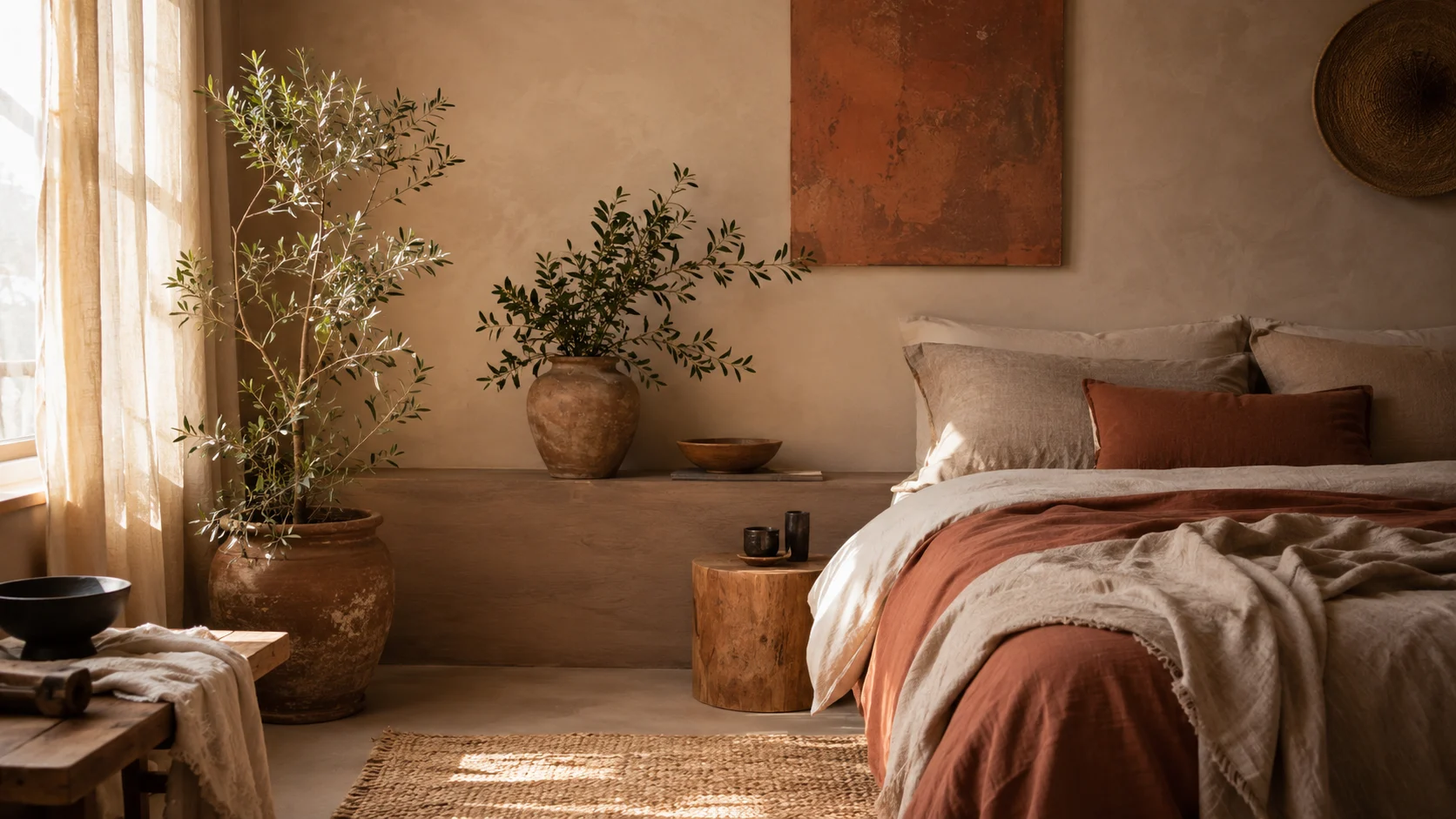
The beauty of clay-based colors is how they interact with metals and fabrics. If you have copper light fixtures or bronze hardware, a terracotta wall will make those metallic elements glow. Textiles also play a huge role in how we perceive this color. Imagine a terracotta wall paired with a heavy cream linen sofa and a jute rug. The variety of textures keeps the warm color from feeling overwhelming or dated.
When this color fails, it’s usually because the surrounding elements are too cold. Avoid pairing a rich terracotta with stark, blue-toned whites or polished chrome. Instead, lean into the warmth. Use off-whites, warm oaks, and matte black accents. This creates a balanced ecosystem within the room where the walls feel like a natural extension of the floor and furniture. It’s a color that celebrates the imperfect, hand-crafted nature of the earth itself.
Ochre and Harvest Gold as Natural Light Amplifiers
Ochre is one of the oldest pigments used by humans, found in cave paintings dating back tens of thousands of years. It’s a golden-yellow earth tone that feels sun-drenched even on a cloudy day. In a living room, ochre provides a cheerful energy without the frantic intensity of a primary yellow. It feels like harvested wheat or the late afternoon sun hitting a canyon wall.
I often suggest ochre for rooms that lack natural light. Because it has such a strong yellow base, it reflects any available light and warms it up. However, the key is to ensure the ochre has enough brown in it to remain “earthy.” If it’s too clean, it loses that organic connection. A true earthy gold should feel substantial and weighted, like a heavy mustard or a piece of raw amber.
Pairing ochre with deep navy or charcoal can create a stunning, high-end look, but if you want to stay strictly within the earthy realm, try pairing it with olive green or chocolate brown. This creates a forest-floor aesthetic that is incredibly soothing. One of my favorite applications was in a library-style living room where we painted the built-in bookshelves the same ochre as the walls. The monochromatic approach made the entire room feel like it was carved out of a single block of warm stone.
Raw Umber and the Sophistication of Deep Brown Earth
Brown is making a massive comeback in interior design, but we aren’t talking about the flat, muddy browns of the 1970s. Modern earthy browns, like raw umber or espresso, are rich and dimensional. A deep brown living room can be incredibly sophisticated, acting as a dark neutral that allows every other color in the room to shine. It’s the color of fertile soil and ancient tree bark.
Many people are terrified of dark brown walls, fearing they will turn their living room into a cave. But a cave isn’t necessarily a bad thing if it’s well-lit and thoughtfully textured. In a large, airy living room, a dark umber wall can provide a much-needed sense of scale. It stops the room from feeling like a vast, empty void. When you use brown, you’re leaning into the ultimate grounding color, the very foundation of the earth.
To make brown work, you must incorporate various light sources. You can’t rely on a single overhead light; you need floor lamps, table lamps, and perhaps even some picture lights to highlight specific areas of the wall. This creates highlights and shadows that give the brown paint a velvet-like appearance. When you touch a matte brown wall, it should almost feel like you’re touching suede. This tactile quality is what separates a professional earthy design from a basic paint job.
Greige and the Evolution of Modern Warm Neutrals
If you aren’t ready to commit to a bold terracotta or a deep green, greige is your best friend. This color is the perfect marriage of grey and beige, offering the coolness of stone with the warmth of sand. It’s the quintessential earthy neutral. Greige is incredibly versatile, changing its personality based on the colors you put next to it. It’s the color of a weathered pebble or a sun-bleached driftwood log.
The mistake many people make with neutrals is choosing one that is too “clean” or “flat.” An earthy greige should have a complex DNA. It might have a hint of green, a dash of violet, or a whisper of yellow. These subtle undertones are what make the color look expensive and custom. In a living room, a greige wall allows your artwork and furniture to be the stars of the show while still providing a warm, organic envelope for the space.
I recently consulted on a modern farmhouse project where the owners wanted a “clean” look that didn’t feel cold. We settled on a mushroom-toned greige. By using a flat matte finish on the walls and a slightly glossier version of the same color on the trim, we created a sophisticated, layered look without introducing any other colors. It’s a masterclass in subtlety. This approach proves that earthy doesn’t always have to mean “dark” or “heavy.” It can be light, airy, and ethereal.
Dusty Rose and Muted Mauve as Earthy Accents
It might surprise some to see pink on an earthy color list, but think about the colors of a desert sunset or the inside of a seashell. A dusty, muted rose is a beautiful earthy tone that brings a soft, feminine energy to a living room. This isn’t “Barbie” pink; it’s the color of dried clay or old brick. It has a heavy dose of brown and grey, which keeps it from feeling sugary or childish.
Using a muted rose can soften the hard lines of a modern living room. If you have a lot of stone, metal, or dark wood, a dusty rose wall can provide a necessary counterpoint. It feels organic and warm, like the glow of a fading fire. I’ve seen this work beautifully in a room with deep velvet sofas in forest green. The contrast between the pink walls and the green furniture is classic and rooted in nature’s own palette.
When selecting an earthy pink, always look at the swatch next to a piece of brown cardboard. If the pink looks too bright or “neon” against the brown, keep looking. You want a pink that almost looks like a warm beige in certain lights. This ensures that the color stays within the organic family. It’s a sophisticated choice for those who want a touch of color that still feels mature and grounded.
Slate Grey and Stone Hues for Structural Balance
The earth isn’t just soil and plants; it’s also rock and mineral. Slate grey is an essential earthy tone that provides a cool, structural balance to a palette of warm clays and greens. This is the color of a mountain range or a stormy sky over the plains. In a living room, slate grey can be very calming, providing a sense of permanence and strength.
Many people shy away from grey now, thinking it’s “out,” but that’s only true for the clinical, blue-toned greys that dominated the last decade. Earthy slate has a bit of green or brown in its base, making it feel like natural stone rather than industrial concrete. It’s a fantastic color for a fireplace wall or an accent behind a television, as it helps the black screen disappear into the background.
Pair slate grey with raw wood and wool rugs to keep it from feeling too cold. The interplay between the “hard” color of the wall and the “soft” textures of the room creates a dynamic tension that is very pleasing to the eye. It’s the same feeling you get when you see a soft moss growing on a hard granite boulder. By mimicking these natural pairings, you create a living room that feels authentic and timeless.
Practical Application and Light Reflectance Strategy
Choosing the right color is only half the battle; you also have to consider the Light Reflectance Value, or LRV. This is a scale from 0 to 100 that tells you how much light a color reflects. Most earthy colors have a lower LRV, meaning they absorb more light. This is why they feel so cozy and grounded. However, if you have a very dark room with small windows, choosing a color with an LRV below 20 might make the space feel too dim.
I always recommend painting a large sample board and moving it around the room throughout the day. Watch how the color changes at 8 AM, 2 PM, and 8 PM. You might find that the perfect sage green looks like a dull grey in the morning but turns into a beautiful, vibrant leaf color in the afternoon. This is the “metamerism” of paint—the way a color appears to change under different light sources. Don’t rush this process; the earth took millions of years to create these colors, so you can take a few days to choose the right one.
Finally, consider the finish. For earthy colors, a matte or flat finish is almost always the best choice. Shimmer and gloss are rare in the natural world outside of water and crystals. A matte finish allows the pigment to speak for itself without the distraction of light reflecting off the surface. It gives the walls a chalky, mineral quality that feels much more authentic to the organic aesthetic. If you’re worried about durability, modern matte paints are much more washable than they used to be, so you don’t have to sacrifice function for form.
Wrap Up
Selecting an earthy paint color is about more than just following a design trend; it is about creating a habitat that supports your well-being. Whether you choose the quiet calm of sage or the bold warmth of terracotta, these colors bring the stabilization of the natural world into your daily life. Focus on the undertones and the way light interacts with the pigments to ensure a professional result. By grounding your living room in these organic hues, you create a timeless sanctuary that will feel relevant and restorative for years to come.
FAQs Section
Which earthy paint color is best for a small living room with limited natural light? A warm, mushroom-toned greige or a light ochre works best because these shades have enough yellow or beige to reflect light while maintaining a grounded, organic feel. Avoid deep umbers in small, dark spaces unless you are intentionally aiming for a very dark, moody “den” aesthetic.
Can I mix multiple earthy colors in one living room without it looking cluttered? Yes, earthy tones are naturally harmonious because they share similar “muddy” undertones, allowing you to pair a sage green with terracotta accents quite easily. The key is to keep the saturation levels similar so that no single color overwhelms the others in the space.
What kind of furniture pairs best with an organic earthy color palette? Natural materials like white oak, walnut, linen, and jute are the ideal companions for earthy walls because they reinforce the biophilic theme. Steer clear of high-gloss plastics or overly ornate metallic finishes, which can clash with the humble and raw nature of an earth-toned environment.