TL;DR
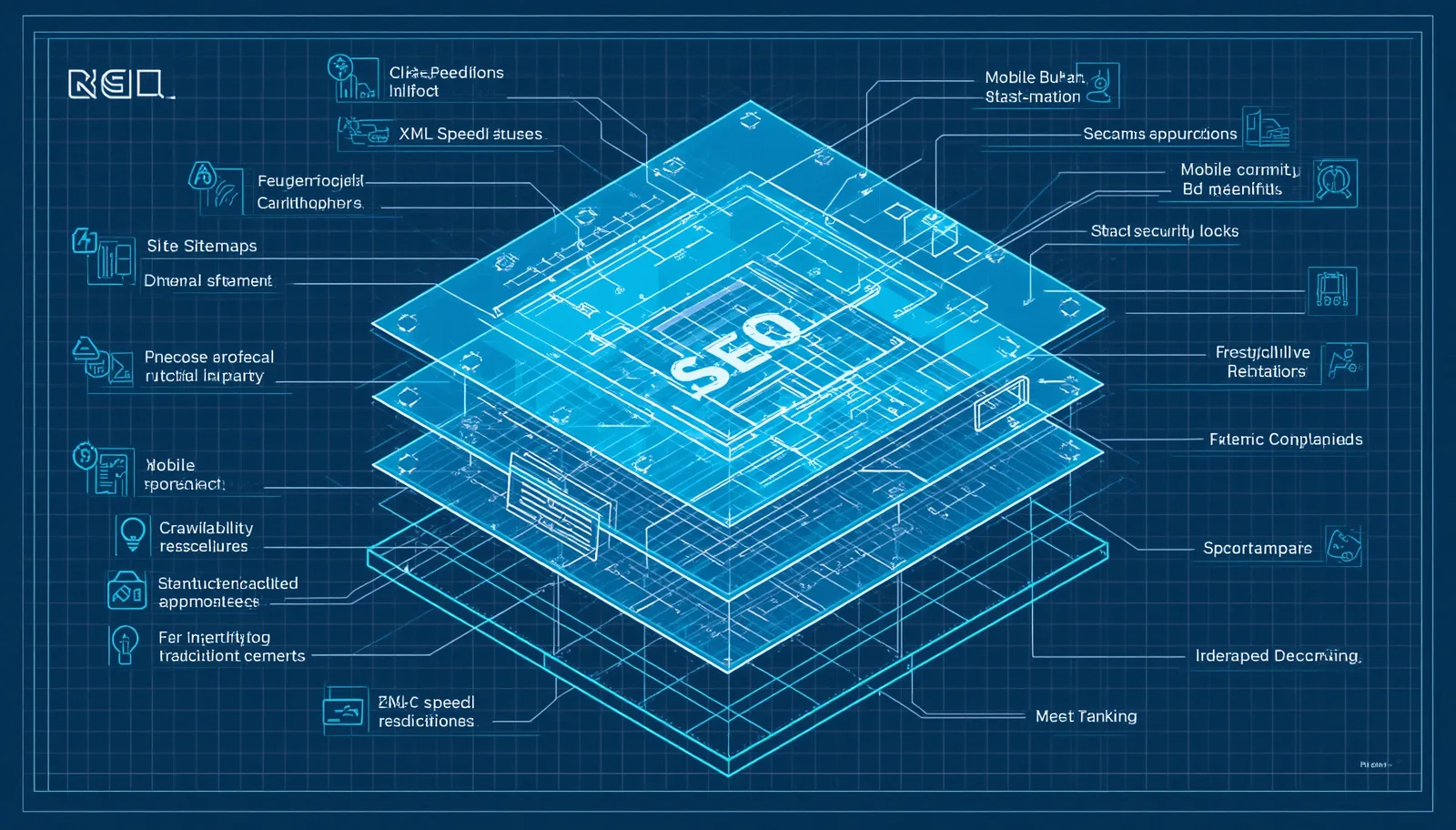
Technical SEO is the process of optimizing a website’s infrastructure so search engines can crawl, interpret, and index its content without friction. It covers everything from site speed and mobile usability to structured data and canonical signals. Without a solid technical foundation, even the strongest content strategy will underperform.
What Technical SEO Actually Means
Most people hear “SEO” and picture keyword research and content calendars. Technical SEO sits underneath all of that. It is the discipline of making sure search engines can physically access, read, and understand a website, the way an architect ensures a building has working electrical wiring before anyone worries about the paint color.
Technical SEO refers to the configurations, optimizations, and signals that govern how search engine crawlers interact with your website. It does not directly change what a page is about. It changes whether that page gets seen at all. A well-written article buried behind slow load times, broken redirect chains, or thin duplicate content is, from Google’s perspective, practically invisible.
The phrase has been in wide use since search engines began publishing their own documentation on crawl budgets and rendering behavior. Its meaning has expanded considerably as modern websites grew more complex, adding JavaScript frameworks, internationalization layers, and dynamic content that older crawlers were never designed to handle.
The Core Technical Pillars Search Engines Care About
Crawlability: Can Search Engines Find Your Pages?
A crawler, sometimes called a bot or spider, moves through a website by following links. If a page has no inbound links, sits behind a login wall, or is explicitly blocked in a robots.txt file, that page will not be crawled. Many site owners have spent months producing content that was accidentally blocked from the start, not by a penalty, but by a misconfigured disallow rule left over from a staging environment.
Crawlability also depends on internal linking structure. Pages buried six clicks deep from the homepage receive less crawl attention than pages sitting two clicks away. This is not theoretical. During audits of mid-size e-commerce sites, product pages that required navigating through three category filters before appearing were consistently under-indexed compared to those accessible from the site’s primary navigation, even when both had identical content quality.
The robots.txt file is often the first place a technical audit begins, not because it is the most complex file on a website, but because a single wrong directive can inadvertently block an entire subdirectory. Pairing that file review with an XML sitemap check gives a clear picture of what a site intends to show search engines versus what it actually allows them to see.
Indexability: Getting Pages Into the Search Engine’s Database
Crawling and indexing are two separate events. A search engine can crawl a URL, find a noindex meta tag, and then deliberately exclude that page from its index. This is sometimes intentional, and sometimes a developer accident that nobody notices for months.
Indexability problems tend to be quieter than crawlability problems. A blocked page typically generates a visible traffic drop. A noindex tag on a key landing page might go undetected until someone runs a site search query and notices the page simply never appears. The canonical tag is another signal in this space. When multiple URLs serve similar or identical content, such as filtered versions of a product catalog page, the canonical tag tells search engines which version to treat as the authoritative one.
Duplicate content is one of the more misunderstood technical issues. Google does not penalize duplicate content in the traditional sense. It consolidates ranking signals to a preferred URL, which means that if a site has ten versions of the same product page at different URLs, the ranking equity gets diluted rather than amplified.
Site Speed and Core Web Vitals
Page speed has been a ranking signal for desktop searches since 2010 and for mobile since 2018. The introduction of Core Web Vitals (CWV) as a ranking factor marked a shift toward measuring not just raw loading time but actual user experience. The three primary metrics are Largest Contentful Paint (LCP), which measures loading performance; Interaction to Next Paint (INP), which captures responsiveness; and Cumulative Layout Shift (CLS), which quantifies visual stability.
A page that jumps around as it loads, or one that makes a user wait 4.5 seconds to see its main content, fails not just on Core Web Vitals but on the implicit promise a website makes to a visitor. Search engines reflect that user experience in rankings, which is why a technically sound page with average content will often outperform a brilliant article on a slow, unstable site.
Improving LCP typically involves optimizing the largest element on a page, often a hero image or a render-blocking web font, so that it loads without waiting for non-critical resources. Reducing CLS usually requires reserving space for elements like ads, embeds, and lazy-loaded images before they render.
Structured Data and How Search Engines Understand Context
What Schema Markup Actually Does
Structured data is code, typically written in JSON-LD format, that labels the content on a page with a standard vocabulary. When a recipe page includes structured data, Google understands which text is the ingredient list, which is the prep time, and which is the author’s name. Without that markup, it can still infer this information, but the inference is less reliable.
Schema.org is the shared vocabulary maintained by the major search engines for this purpose. Applying the right schema type, whether that is Article, Product, FAQPage, LocalBusiness, or BreadcrumbList, increases the likelihood that a page qualifies for rich results in SERPs. Rich results, the visual enhancements like star ratings, recipe thumbnails, or FAQ accordions that appear beneath a result title, have repeatedly shown higher click-through rates than standard blue links.
One pattern worth noting: sites that implement structured data inconsistently, applying it to some pages and not others, often see a patchwork of rich results that confuses rather than impresses. A coherent schema strategy across every content type produces more predictable outcomes than a tactical application to only the most visible pages.
Internal Linking as a Structural Signal
Internal links are how equity flows through a website. Each link from one internal page to another passes a portion of that page’s authority forward. This is not a simple linear transfer. The number of other links on the page, the relevance of the linking page to the linked page, and the anchor text used all influence how much value the link passes.
A well-architected internal linking system treats the site the way a publishing house treats a book series: flagship content earns prominent links from many internal pages, while supporting content links up toward those pillars. Sites that treat internal linking as an afterthought, adding links only when they occur naturally in body copy, leave measurable ranking equity sitting unused in high-authority pages that point nowhere.
Mobile Optimization and the Reality of Mobile-First Indexing
Google has operated mobile-first indexing as its default since 2019. This means the version of a website it primarily crawls and indexes is the mobile version. If a site’s mobile experience hides content behind tabs, loads a stripped-down version compared to desktop, or uses interstitials that block the main content, the indexed version of that site reflects those deficiencies.
Responsive design, where a single HTML document adapts its layout to the screen size, is the approach Google recommends. Separate mobile subdomains (the old m. approach) still work but require careful canonical and alternate tag implementation to avoid confusing the indexer about which version is canonical.
HTTPS, Security, and Trust Signals
HTTPS has been a ranking signal since 2014. The practical reality today is that browsers actively warn users when they visit an HTTP site, which means any site still running on an unencrypted connection is losing visitors before it even has a chance to lose rankings. The migration from HTTP to HTTPS is generally straightforward, but careless migrations that fail to redirect old URLs to their HTTPS equivalents can disrupt accumulated link equity.
Beyond the certificate itself, technical security configurations, such as preventing mixed content (HTTP resources loaded on HTTPS pages) and implementing correct redirect chains, fall under the technical-SEO umbrella. A page that loads over HTTPS but fetches images or scripts from HTTP sources generates browser warnings that erode the trust signal.
Real-World Application: Two Cases Worth Examining
A travel content site with roughly 800 published articles experienced a plateau in organic traffic after two years of consistent growth. A technical audit revealed that their category pages, which aggregated destination guides, were generated dynamically and each produced a unique URL with a different query parameter combination. There were over 3,400 parameterized category URLs competing with the 800 canonical articles for crawl budget and indexation. Implementing canonical tags pointing all parameterized versions to the base category URL, and blocking the parameterized URLs in robots.txt, freed crawl budget for content pages. Organic traffic rose around 28% over the following three months without a single new article being published.
A local services business, a plumbing company with multiple city-specific landing pages, struggled with Google indexing only its homepage consistently. The issue was a sitemap that referenced absolute URLs beginning with http:// while the actual site had migrated to https:// six months earlier. Crawlers followed the sitemap to redirect chains that resolved correctly in browsers but created unnecessary crawl hops. Updating the sitemap to use correct HTTPS URLs, adding proper 301 redirects with no intermediate hops, and submitting the corrected sitemap through Google Search Console resolved the indexing inconsistency within five weeks.
How Technical-SEO Connects to Broader Discoverability Systems
Technical SEO does not operate in isolation. The same principles that govern how search engines parse structured signals apply, in a structural sense, to how other algorithmic systems categorize and surface content. Tools like a Moon Sign Calculator, for example, must surface accurate astrological content built around entities like the LEO Moon Sign or specific planetary positions, and they rely on proper structured data and clean URL architecture to be found and trusted in search results. The parallel is direct: technical clarity enables any discovery system, whether it is a search engine crawling a news site or a user searching for a personalized Leo Moon Sign reading, to return accurate, reliable results.
The Ongoing Nature of Tech SEO
Technical SEO is not a project with a defined end point. Websites evolve. Content gets migrated, templates get rebuilt, CDNs get reconfigured, and each change introduces potential for new technical debt. A site that was technically clean in one year may carry genuine problems eighteen months later simply from organic development activity.
The discipline rewards ongoing attention more than periodic large-scale audits. Monthly crawl reports, continuous Core Web Vitals monitoring, and regular log file analysis to understand actual bot behavior are all practices that separate sites that hold rankings over years from those that recover from setbacks repeatedly.
Structured data validation, crawl budget monitoring, redirect chain auditing, and canonicalization hygiene are not glamorous tasks, but they produce compounding returns. Every page Google can crawl efficiently, index correctly, and understand contextually is a page that has a genuine chance to compete on its own merit.
Wrap Up
Technical SEO is the non-negotiable foundation beneath every other SEO investment. Content strategy, link building, and user experience improvements all depend on search engines being able to find, crawl, and understand a website without confusion. Addressing the fundamentals, crawlability, indexability, page speed, structured data, and mobile performance, gives every other channel a fair chance to perform. Start with a crawl audit, fix what blocks access, and work methodically through the technical stack before adding more content to an infrastructure that may not be serving what is already there.
Frequently Asked Questions
What is the difference between technical SEO and on-page SEO?
Technical SEO addresses the infrastructure of a website, including crawlability, site speed, and structured data, while on-page SEO focuses on the content and keyword relevance of individual pages. Both are needed for strong organic performance.
How often should a technical SEO audit be performed?
A thorough audit is worth conducting every six to twelve months, with ongoing monitoring of Core Web Vitals, indexation status, and crawl reports in between to catch issues as they arise rather than after they have suppressed rankings.
Does technical SEO affect how quickly new content ranks?
Yes. A technically sound site with a healthy crawl budget and fast load times will typically see new content indexed and evaluated faster than a site with crawl inefficiencies. Faster indexation means ranking signals, positive or otherwise, accumulate sooner.